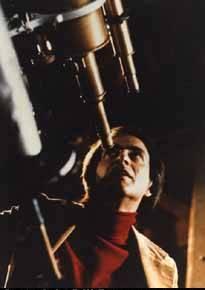
This Blog Site was established as an Internet Monument to one of the greatest Astronomers and popularizers of science of the twentieth century - Dr. Carl Sagan. Cosmos was the landmark documentary for which he will be long remembered. This Internet Project is dedicated to his life, work and memory. Herein we will discuss many of the issues that occupied Sagan throughout his life (Astronomy, SETI, the future of humanity, space exploration, science and education).
It was one year ago today that Arthur C. Clarke went on his final odyssey into the infinite. Today on Cosmic Visions we would like to pay homage to the Man who inspired three generations of men and women to pursue careers in science and space with his visionary writings. Sir Arthur was and will always remain the…….
The Man Who Saw the Future
Referred to as a genius, this one man think tank is considered the ultimate futurist by his devoted fans. How is it that Clarke's views of the future, as described in his many novels, have often become very present realities, such as videophones, laptop computers, E-mail, the space shuttle and cloning? One thing is for sure, Arthur C. Clarke is one of the most celebrated science fiction authors of our time. His novels 2001: A Space Odyssey and most recently 3001: The Final Odyssey, as well as more than 60 other titles have inspired generations of people, propelling us into the future, setting our minds free to explore.
You can purchase this wonderful documentary from AMAZON.COM
And, for your viewing pleasure and in order to honour Clarke’s contributions to the genre of science fiction we have:
The Martians and Us -From Apes to Aliens Episode 1.
A series about the history of British science fiction. This edition looks at our relationship with aliens, from Wells' invading Martians to the Daleks, via 2001: A Space Odyssey, the Midwich Cuckoos, and the Mekon. It also explores the genre's preoccupation with the big questions of evolution, and includes interviews with Arthur C Clarke, Brian Aldiss, Doris Lessing and Steve Jones.
Today on Cosmic Visions we continue our year long celebration of the life and work of the naturalist Charles Darwin with the second episode of the landmark PBS television series “Evolution” - Great Transformations. What underlies the incredible diversity of life on Earth? How have complex life forms evolved? The journey from water to land, the return of land mammals to the sea and the emergence of humans all suggest that creatures past and present are members of a single tree of life.
Today marks the bicentennial of Charles Darwin’s birth. In order to mark the occasion of Darwin’s birth on 12th February, 1809 and the 150th anniversary of Darwin’s publication of “On the Origin of Species” on 24th November, 1859 today we are going to take a closer look at Darwin's idea on the origin of species. Some have even labelled Darwin's Theory of evolution by Natural Selection a "Dangerous Idea”. Today’s video offering takes a closer look at this ''dangerous idea'' and explores why it matters more today than ever. Does it explain the past history and predict the future of life on Earth? Can it explain how life may have arisen on Earth and perhaps elsewhere in the Cosmos? This documentary interweaves the drama of Darwin's life with current documentary sequences, introducing the key concepts behind Darwin’s Theory of evolution.
This is the extraordinary story of how a small metal disc is rewriting the epic saga of how civilisation first came to Europe, 3600 years ago.
When grave robbers ransacked a Bronze Age tomb in Germany, they had no idea that they had unearthed the find of a lifetime. But they knew that it was worth selling. It was a small bronze disc of exquisite design. So they contacted the archaeologist Harald Meller, offering to sell it to him for £300,000.
Meller went deep into the criminal underworld and, after a police sting, he got his disc. It depicted the sun, the moon and the stars. This suggested an understanding of the heavens greater than that of the first great civilisations, like Egypt. Could it possibly be real?
After exhaustive tests, the disc was declared genuine. Then a team of crack scientists pieced together what it meant. What emerged is a true marvel.
In order to kick off a year of celebration to commemorate the bicentennial of Charles Darwin’s birth on 12th February, 1809 and the 150th anniversary of Darwin’s publication of “On the Origin of Species” on 24th November, 1859 today on Cosmic Visions we are going to explore the possibility of life elsewhere in the Cosmos.
Whatever form life takes on elsewhere in the cosmos we can be reasonably certain that the same inexorable laws of evolution through natural selection that shaped life on Earth will shape it elsewhere. Natural selection has given rise to an incredible diversity of life on this planet. Over the past four billion years, this has resulted in a plethora of living organisms each adapted and specialize to occupy a particular ecological niche and eventually the emergence of new species. If life exists elsewhere we can very well expect it to reflect and perhaps surpass the almost inconceivable variety of life on our world.
Yet when studying the wonderful history of life on our planet we are faced with a spectacular conundrum. Natural selection has shaped and sculpted an incredible life form that appears to be able to adapt to life in every conceivable ecological niche. A life form that is on the verge in directing the course of its own evolutionary future and also of creating life forms that will transcend biology in silico. And, that life form is us – Homo sapiens. We are the pioneers of a whole new form of evolution which is distinctly non-biological. This new realm of evolution is Cultural Evolution. It is this new dominion of evolution that has made us the most dominant life form on this planet and has set us on a trajectory that will one day take us out amongst the stars. Will we one day encounter other such life forms or their living machines out amongst the starry ferment?
It is indeed very conceivable that the first intelligent life forms that we will encounter will be living machines capable of self replication and also transcending Darwinian evolution. These living machines may very well continue to evolve in the most non-Darwinian of ways via Lamarckian evolution.
"...Self-reproducing probes or robots, free from such restraints [Darwinian evolution], could advance by Lamarckian evolution. That is, they could pass on directly any acquired abilities and desired improvements to the next generation, and evolve rapidly capabilities beyond the reach of biological beings." - Edward Ashpole, The Search for Extra-terrestrial Intelligence
Then the future struggle for existence may indeed be between the biological and non-biological entities played out on a galactic scale. We will explore these questions in a later series of articles. In the meantime enjoy today’s video offering as we explore the possibility of life in Darwin’s Universe.
The Universe - Alien Faces
They roam the planetary surface, fly underwater and soar through the heavens. But this is no wildlife safari on planet Earth; this is an expedition of astronomical proportions. When the human race discovers it is not alone, what will our cosmic brothers and sisters look like? To answer this question leading astronomers and Astrobiologists have applied the principals of evolution and physics to five types of alien worlds likely to be found in the cosmos. These are the creatures that could be out there. Prepare to take an intergalactic safari and peer directly into the eyes of alien faces.
Exploring Space - The Quest for Life
This film takes a great comprehensive look at space travel, life on other planets, and the origins of life on Earth. It does a great job of exploring such topics as Pasteur's experiments with wine barrels, the origins of life on earth, recent discoveries of life in expected places on earth, dust from comets, Jupiter's moon Europa, human's endurance in space, terraforming prospects on Mars, the requirements of a mission to Mars. It's strength is the effective way it illustrates very complicated concepts using great interviews, interesting comparisons, and good visual effects. Unlike other documentaries of this type, this one goes into greater depth with various concepts and ideas.
In the Beginning, in a burst of pure radiant energy, light came into being and in that brief instant of creation the Universe came into existence some fourteen billion years ago. Within the first three minutes of the big bang pure energy condensed into matter. From this matter stars and galaxies came forth and through the process of nuclear fusion, heavy elements were forged in the hearts of distant and massive suns. It is the existence of these elements that make the existence of living things a possibility. We owe are very existence to that very instance when the laws of physics through accident or design (depending on your philosophical and religious proclivities dear reader) declared, eons ago –“Let there be Light”.
The study of the fundamental nature of light has been a central theme throughout the Intellectual History of humanity. Answering the question – “what is light?” has been a major preoccupation of all major areas of human endeavour be it Religion, Philosophy or Art. The quest to understand and decipher the mystery of radiance gave rise to modern science. In fact, the twin pillars of modern science – Relativity and Quantum Mechanics owe their development to solving the mystery of the true nature of light. And, it is through the analysis of starlight that humanity has begun to understand its place in the Cosmos. So my dear readers, in the earnest hope that this New Year and the years to follow, will always be radiant with the promise of hope and good fortune for each and everyone of you I would like to offer you the following documentary for your viewing pleasure: Simon Schaffer's fantastic four part documentary "Light Fantastic" that was produced for BBC 4. In the episodes that follow science historian Simon Schaffer takes on a voyage of discovery through time to follow humankind’s quest for enlightenment to discover the true nature of light.
1. Let There be Light
Greek and Arab scholars and later Europeans such as Descartes and Newton all tried to understand light to gain a better understanding of God. Episode one shows how much of modern science's origins came from the desire to penetrate the divine nature of light.
2. The Light of Reason
The second programme explores the link between the development of practical tools that manipulate light and the emergence of new ideas. For example, Galileo's observation that the sun did not go around the earth, was made with a telescope that had been invented for Venetian soldiers and traders.
3. The Stuff of Light
Episode three charts the discovery of the true nature of light and its impact on the modern world. All of today's technologies - electricity, mobile communications and our ability to illuminate the world 24 hours a day - stem from unravelling the mystery of light.
4. Light, The Universe and Everything
In the final programme Simon Schaffer finds that as more people were able to manipulate light, the more puzzling and tricky it became. This led to investigations into the strange relationship between light, the eye and the mind, and the development of new technology such as photography and cinema.
The New Year ahead of us promises to be an exciting one for those of us on Discovery Enterprise and the associated blog sites Cosmic Visions and Far Future Calling. This New Year of 2009 AD promises to be one of many New Beginnings in the exciting world of Discovery, Exploration and Science.
Many of our devoted readers know that we at Discovery Enterprise are closely associated with the Atlantica Expeditions - First Undersea Colony Project. At this very moment the Atlantica Expeditions Team is assembling the New Worlds Explorer (NWE) and it will be nearing completion this weekend. The New Worlds Explorer, designed by Dennis Chamberland, is designed as a companion habitat and engineering model to the Leviathan Habitat, scheduled for construction soon. Both habitats will be used to support underwater crews on the longest manned underwater mission in history in 2010. The New Worlds Explorer is scheduled for deployment in 2009. As for other news – it looks like the submarine Dan Scott Taylor II will be delivered in January! It looks like it is going to be a busy and eventful year as the Atlantica Expedition crew embarks on its quest to commence humankind's exploration and settlement of the last great frontier on Earth - the Undersea World of Aquatica.
The year 2009 also marks the celebration of four major anniversaries connected to the History of Science and Exploration. 2009 marks the bicentennial of Charles Darwin’s birth on 12th February, 1809 and the 150th anniversary of Darwin’s publication of “On the Origin of Species” on 24th November, 1859. The year 2009 will also mark the 400th anniversary of the use of the telescope to view the heavens by Galileo Galilei and the publication of Johannes Kepler's Astronomia Nova in which he presented his three laws of planetary motion. In connection with these events the year 2009 has been declared the International Year of Astronomy.
Moreover, it will also commemorate the 40th anniversary of the 1st landing by human beings on the moon's surface on July 20th, 1969. This year will also see the launching of the Kepler Mission on March 6th, 2009 an astronomical satellite currently being developed by NASA to search for Earth-like planets orbiting other stars. It will observe the brightness of over 100,000 stars over 3.5 years to detect periodical transits of a star by its planets.
And on July 11th, 2009 will see the test launch of the Ares I-X which will be a suborbital test flight in of the Ares I spacecraft. This will be the first major step, in NASA’s ambitious plans to return to the Moon, with the eventual goal of establishing a permanent human presence there. So stay with us dear readers and join us on new voyages of exploration and discovery during the exciting year ahead.