Sunday, March 14, 2010

Space Colonies: Living Among the Stars


"Teetering here on the fulcrum of destiny stands our own bemused species. The future of the universe hinges on what we do next. If we take up the sacred fire, and stride forth into space as the torchbearers of Life, this universe will be aborning. If we carry the green fire-brand from star to star, and ignite around each a conflagration of vitality, we can trigger a Universal metamorphosis. Because of us, the barren dusts of a million billion worlds will coil up into the pulsing magic forms of animate matter. Because of us, landscapes of radiation blasted waste, will be miraculously transmuted: Slag will become soil, grass will sprout, flowers will bloom, and forests will spring up in once sterile places. Ice, hard as iron, will melt and trickle into pools where starfish, anemones, and seashells dwell — a whole frozen universe will thaw and transmogrify, from howling desolation to blossoming paradise. Dust into Life; the very alchemy of God".

Marshall T. Savage, author of The Millennial Project: Colonizing The Galaxy In Eight Easy Steps.


Today on Cosmic Visions we take an exciting voyage into the future and explore the wonderful and exciting possibility of humanity expanding outwards from its planetary abode to make its home amongst the stars.


In “Space Colonies: Living Among the Stars” we examine the scientific basis for the growing belief that humans can and will carry our civilization far from Earth through the eyes of such visionaries as Marshal T. Savage, Robert Zubrin, Christopher McKay, Jim Benson and Gerard K O’Neill.

Space Colonies : Living Among the Stars

Carl Sagan’s Contact


As we approach the fiftieth anniversary of the establishment of the Search for Extraterrestrial Intelligence (S.E.T.I.) as a bona fide branch of legitimate scientific inquiry we cannot help but wonder how "First Contact" will occur and what effect this will have on humanity.

Today we explore this exciting possibility through the vision of Dr. Carl Sagan as outlined in his first and only science fiction novel “Contact” published in 1985 and the film adaptation released twelve years later.


The novel and book both present a unique and wonderful vision of a common science fiction theme about the first meeting between humans and extraterrestrial life. Sagan expands on this theme in his novel and hints at the possibility of an even higher overarching intelligence that existed before the creation of the Cosmos and responsible for bringing into being. Unfortunately in the motion picture this was only touched upon obliquely.


Eleanor "Ellie" Arroway is the director of "Project Argus," in which scores of radio telescopes in New Mexico have been dedicated to the search for extraterrestrial intelligence (SETI).

Before long, the project does, indeed, discover the first confirmed communication from extraterrestrial beings, a repeating series of the first 261 prime numbers (a sequence of prime numbers is a commonly predicted first message from alien intelligence, since mathematics is considered a "universal language," and it is conjectured that algorithms that produce successive prime numbers are sufficiently complicated so as to require intelligence to implement them). Further analysis of the message reveals that two additional messages are embedded in the signal. One of these messages is the detailed instructions of a machine that transports professor Arroway on an incredible odyssey to the heart of the Milky Way Galaxy and a face to face encounter with the intelligent beings that sent the message.

In a kind of postscript, Ellie, acting upon a suggestion by the senders of the Message, works on a program which computes the digits of π to record lengths and in different bases. Very, very far from the decimal point (ten to the twentieth power) and in base 11, it finds that a special pattern does exist when the numbers stop varying randomly and start producing 1s and 0s in a very long string. The string's length is the product of 11 prime numbers. The 1s and 0s when organized as a square of specific dimensions form a rasterized circle.

The extraterrestrials suggest that this is an artist's signature, woven into the very fabric of space. It is another Message, one from the universe's creator. Yet the extraterrestrials are just as ignorant to its meaning as Ellie, as it could be still some sort of a statistical anomaly. They also make reference to older artefacts built from space time itself (namely the wormhole transit system) abandoned by a prior civilization. A line in the book suggests that the image is a foretaste of deeper marvels hidden even further within Pi. This new pursuit becomes analogous to SETI; it is another search for meaningful signals in apparent noise. This idea, among other plot points, was omitted from the film version.


While both the novel and film stand on their own merits one wonders if the film could have attained the same distinction as a cult classic like Stanley Kubrick’s “2001” if this latter theme were worked into the motion picture.


Contact The Motion Picture


Thursday, March 11, 2010

The Universe - Alien Galaxies


Today on Discovery Enterprise we are going to embark on an intergalactic odyssey to visit the hundreds of billions of galaxies that in make up our universe. This is a journey that will take us back to the dawn of time.

The Universe - Alien Galaxies


Sunday, December 20, 2009

The Best of Cosmos – Remembering Carl Sagan


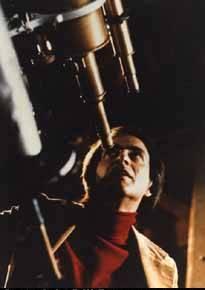
Today on Cosmic Visions we commemorate the memory of Carl Sagan who died an untimely death thirteen years ago today. Carl Sagan, was an astronomer, astrochemist, author, and highly successful popularizer of astronomy, astrophysics and other natural sciences. He pioneered exobiology and promoted the Search for Extra-Terrestrial Intelligence (SETI). For me personally he will always be remembered and revered as a great teacher who communicated the joys and transcendence of scientific discovery. Carl Sagan’s enduring legacy will always be linked to his ability to convey the wonders of science to the general public and his skill in inspiring the next generation of scientists. Carl Sagan’s name will also be forever linked to the greatest science television series in history – Cosmos.

Sagan made the front cover of Time Magazine (Monday October 20th, 1980) which dubbed him the “Showman of Science.” The cover story, entitled ‘The Cosmic Explainer’ by Frederic Golden contains a very good biographical sketch of Carl and appeared when his landmark documentary Cosmos graced our television screens some thirty years ago.


So in order to commemorate the thirteenth anniversary of his death we are presenting a retrospective of the very best moments and highlights of the highly acclaimed documentary series Cosmos and the A&E Channel’s profile of Carl Sagan which aired shortly after his unfortunate death. It is a very good portrayal of how a kid from Brooklyn made good and became something of a media superstar —“indeed, a supernova of sorts”. So for your perusal “Heeere's Carl, bringing you nothing less than the Cosmos.”

Best of Sagan's Cosmos


Carl Sagan A Biography


Thursday, December 3, 2009

One of Carl Sagan's Most Pertinent Messages for Humanity


"Those worlds in space are as countless as all the grains of sand on all the beaches of the Earth. Each of those worlds is as real as ours. In every one of them, there's a sucsession of incidence, events, occurences which influence its future. Countless worlds, numberless moments, an immensity of space and time. And our small planet, at this moment, here we face a critical branch-point in history. What we do with our world, right now, will propagate down through the centuries and powerfully affect the destiny of our descendants. It is well within our power to destroy our civilization, and perhaps our species as well. If we capitulate to superstition, or greed, or stupidty we can plunge our world into a darkness deeper than time between the collapse of classical civilization and the Italian Renaissaince. But, we are also capable of using our compassion and our intelligence, our technology and our wealth, to make an abundant and meaningful life for every inhabitant of this planet. To enhance enormously our understanding of the Universe, and to carry us to the stars." Carl Sagan explains the immensity of space and time. This clip is from Carl Sagan's Cosmos episode 8, "Journeys in Space and Time."
Carl Edward Sagan (November 9, 1934 – December 20, 1996)

Wednesday, December 2, 2009

Journey to 10,000 B.C


Today on Discovery Enterprise we journey to the year 10,000 BC and experience the suspense and heart-pounding action of a woolly mammoth hunt. A single kill could feed the tribe for weeks. As the winters grow curiously colder and longer, this vital source of nourishment becomes even more critical. Experience the land where giant ground sloths, great saber-toothed cats, and camels roamed. Witness their extinctions and live through the cataclysms that we are only now beginning to understand.

Journey to 10,000 B.C.


Tuesday, December 1, 2009

The Search for Shangri-La


The dream of an earthly paradise immune to the squalid wickedness of the world and the ravages of time comes to us from the depths of antiquity. One such place was - Shangri-La.

In the novel “Lost Horizon” published in 1933, James Hilton takes us on an odyssey to the earthly paradise Shangri-La hidden in a valley somewhere in the Himalayas between Tibet and India. Of all of James Hilton’s works this was always my most favourite.

But, is the legend of Shangri-La rooted in some, very real, earthly reality? Did such a place really exist? Today on Discovery Enterprise we are going on an epic voyage in search of the real Shangri-La with renowned BBC journalist Michael Wood in his awe inspiring documentary series “In Search of Myths and Heroes.”

We are also going to teleport ourselves to Shangri-La through the power of cinematic magic and the vision of legendary film director Frank Capra in his film masterpiece that brought James Hilton’s novel Lost Horizon to life on the silver screen.

So join us dear readers and let us take you on a magical voyage away from the dreary drudgery and cares of your everyday life to the far away and carefree world of Shangri-La. May you like, our hero Conway, find your own very real Shangri-La.


In Search of Myths and Heroes – The Search for Shangri-La


Frank Capara's famous motion picture classic - Lost Horizon (1937)