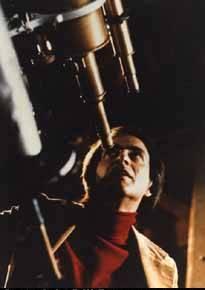
This Blog Site was established as an Internet Monument to one of the greatest Astronomers and popularizers of science of the twentieth century - Dr. Carl Sagan. Cosmos was the landmark documentary for which he will be long remembered. This Internet Project is dedicated to his life, work and memory. Herein we will discuss many of the issues that occupied Sagan throughout his life (Astronomy, SETI, the future of humanity, space exploration, science and education).
This is a short article I wrote for the Discovery Enterprise blogspot on December 31st, 2007. In the light of my most recent article concerning the future exploration and colonization of the Ocean Planets of the Milky Way Galaxy I thought it only appropriate to post it here as well.
Very dear to our hearts on Discovery-Enterprise is the exploration of the undersea world and its eventual colonization. We also dream of humankind’s eventual expansion into the realm of outer space. Central to that dream is the eventual discovery of other Ocean Worlds within our solar system and elsewhere in the Milky Way Galaxy.
No other documentary in recent years epitomizes that dream than the 2005 IMAX documentary ‘Aliens of the Deep’ directed and produced by fellow Atlantica Expeditions crew member James Cameron.
Join us on a voyage of discovery on Earth in our very own Ocean World Aquatica and beyond in search of other life bearing Ocean Planets.
Ever since the early 1980s there has been a great deal of speculation on the possibility of life on Jupiter's moon Europa when it was first deduced that a vast ocean may lie under its icy crust. Here is a wonderful short animated film entitled ‘Europa “Life”’ I found on VeohTV earlier today depicting a fantastic voyage to Europa by an expeditionary space probe and the strange yet somehow familiar and beautiful life forms that we may one day encounter on this enigmatic moon which is in the deepest sense a world on to itself .
Europa "Life"
When viewing this magnificent short animated film I was immediately reminded that humans may one day venture forth to explore and colonize this world. Currently the League of New Worlds is developing the very technologies that will make this possible.
The League of New Worlds is developing the technologies required to explore and one day settle our planet’s own water world –Aquatica.
Aquatica is the Earth’s own planetary ocean. A world integral yet separate from our own. The League of New Worlds is actively engaged in a project that seeks to explore and eventual colonize our planets last great frontier.
As of today, the dream of permanently settling Aquatica has begun, with the immediate, global commitment to long term, intelligent ocean monitoring and the sustainable development of its vast wealth. We also seek to venture there to teach every culture innovative and powerful systems of thought, carved from a profound visionary philosophy – to preserve and protect this vast ocean realm. It is a philosophy vital to our long term survival on this planet and out in the vast frontier of outer space.
The League of New Worlds is currently developing technologies required for us to live in Aquatica and that will help us create a Zero Waste culture where every waste is viewed as a recoverable resource. A philosophy our civilization must embrace to ensure our long term survival on this world and where ever else humankind hopes to settle in the future.
We seek to utilise and not exploit the wealth of the sea and eventually hope to settle there without despoiling it. The very term utilise implies responsible, sustainable and intelligent use of the vast untapped renewable energy, biological and mineral wealth that Aquatica has to offer humankind.
The Atlantica Expeditions seeks to create an intelligent ecological monitoring platform (which now does not exist anywhere) to investigate and understand in detailed scientific terms the full impact of humanity on the ocean environment. The major benefit of this long term project is the preservation of our planet’s most important, largest and most fragile ecosystem.
The league is also developing innovative regenerative life support technologies that will make it possible to live and work in this vast undersea realm. The lessons learned here will ensure humankind’s long term survival on our home world and eventually pave the way for humanity’s next major evolutionary step – the colonization of space and perhaps one day, the other ocean worlds that may exist in the Milky Way Galaxy.
Until that day dawns we must actively work towards protecting and preserving the only planetary home we know – the Earth. So please make it a point to visit our website and find out more about the Atlantica Expeditions.
Also enjoy the wonderful vision of tomorrow outlined in this inspiring video presentation that outlines our vision. A vision developed by fellow blogger and director of the League of New Worlds - Dennis Chamberland.
The Atlantica Expeditions
I have also posted this episode from the BBC television series ‘Hyperspace - Finding New Planets to Live on’, hosted by Sam Neil.
One of my favourite books that came from the pen of Arthur C. Clarke is the "The Exploration of Space" published in 1951. Many of Clarke's predictions about spaceflight as outlined in this book have come true as the video clip recently produced by Apogee Books shows so remarkably well.
I have already posted a small brief tribute to Arthur C. Clarke on the Discovery Enterprise blog spot and spent most of today commemorating his memory tracking videos on You Tube that have been posted to celebrate his memory. The one featured above is my most favourite.
I am continuously amazed not so much by what science has thought us about ourselves and our place in the universe but, by what we don't know. There remain many pertinent questions at the frontiers of science. Nearly two years ago back in July, 2005 the magazine Science of the American Association for the Advancement of Science devoted a special issue to those very questions.
What Is the Universe Made Of?, What Is the Biological Basis of Consciousness?, Are We Alone in the Universe?, How and Where Did Life on Earth Arise?, Do Deeper Principles Underlie Quantum Uncertainty and Nonlocality? and many, many more.
Here is an interesting documentary about things we still do not know hosted by Britain’s Astronomer Royal Martin Rees. We live within the grandest of mysteries. The realm we call -The Universe. Many questions still remain about the nature and our place in this mysterious cosmos and it is going be tremendous fun trying to find answers to them.
Take an exciting voyage to some of the most exotic worlds in our solar system - the moons of Mars, Jupiter, Saturn Uranus and Neptune, each a world in its own right in this exciting documentary first aired on the Discovery channel in the year 2000.
Today I decided to post the entire fourth episode of Carl Sagan's landmark television series Cosmos: "Heaven and Hell". In fact of the all the thirteen episodes this has to rank as one of my most favourites. It was from this episode that I learned about the eyewitness account of a lunar impact seen by Canterbury monks on June 18, 1178 that some researchers believe resulted in the formation of crater Giordano Bruno. This event was recorded in the chronicle of Gervase. Another topic covered in this episode was Tunguska explosion of June 30, 1908. Some researches such as Bill Napier and Victor Clube have linked these two events together as being a byproduct of the Beta Taurid meteor shower; both events coincided with a peak in that shower. I will be covering this topic in a series of articles in commemoration of the upcoming centennial of the Tunguska explosion.
Some researchers have linked the Beta Taurid meteor shower to the collapse of late Bronze Age civilizations and some feel that lurking in its wake are more potential disasters to come. Imagine a Tunguska sized fireball exploding over New York City. The video segment below outlines just such a scenario very vividly.
In today's posting we take a historical perspective concerning the endeavour to find other minds elsewhere in the Cosmos. Man has long speculated about the existence of intelligent life beyond the bounds of Earth. But with the advent of modern astronomy toward the end of the 19th century, old myths were transformed into compelling new theories about alien civilizations. Alien Hunters documents the history of our search for extra-terrestrial life, explaining the technologies used, introducing the pioneers and revealing the most promising discoveries. Experts like Steven J. Dick, Historian of Science at the U.S. Naval Observatory, talk about bizarre 19th century plans to attract alien attention by creating giant canals of flame in the Sahara or enormous earthworks in Siberia. Frank Drake, President of SETI (Search for Extra-Terrestrial Intelligence), provides a modern perspective. And examine mysterious signals from outer space that cannot be satisfactorily explained by any natural phenomenon. It's an inside look at the most ambitious outreach program ever - the search for alien intelligence.
Another great source of information concerning the history of the search for extraterrestrial intelligence is writer David H. Szondy's exciting and wonderful website Tales of Future Past (Life On Other Worlds).
Here are five video clips from this exciting program that aired on The History Channel.
Postscript: Through the kind assistance of Ed Minchau (of Space Video of the Day and Space Feeds Fame) I was able to revise this posting and fit all five video clips into one frame. Thanks very much Ed. Your robot guy and Space feeds site still provide are a tremendous source of inspiration to me. Thanks for the many wonderful videos you posted in the past. Please continue your wonderful work.