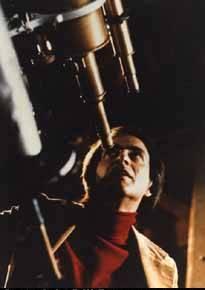
This Blog Site was established as an Internet Monument to one of the greatest Astronomers and popularizers of science of the twentieth century - Dr. Carl Sagan. Cosmos was the landmark documentary for which he will be long remembered. This Internet Project is dedicated to his life, work and memory. Herein we will discuss many of the issues that occupied Sagan throughout his life (Astronomy, SETI, the future of humanity, space exploration, science and education).
This is the extraordinary story of how a small metal disc is rewriting the epic saga of how civilisation first came to Europe, 3600 years ago.
When grave robbers ransacked a Bronze Age tomb in Germany, they had no idea that they had unearthed the find of a lifetime. But they knew that it was worth selling. It was a small bronze disc of exquisite design. So they contacted the archaeologist Harald Meller, offering to sell it to him for £300,000.
Meller went deep into the criminal underworld and, after a police sting, he got his disc. It depicted the sun, the moon and the stars. This suggested an understanding of the heavens greater than that of the first great civilisations, like Egypt. Could it possibly be real?
After exhaustive tests, the disc was declared genuine. Then a team of crack scientists pieced together what it meant. What emerged is a true marvel.
In order to kick off a year of celebration to commemorate the bicentennial of Charles Darwin’s birth on 12th February, 1809 and the 150th anniversary of Darwin’s publication of “On the Origin of Species” on 24th November, 1859 today on Cosmic Visions we are going to explore the possibility of life elsewhere in the Cosmos.
Whatever form life takes on elsewhere in the cosmos we can be reasonably certain that the same inexorable laws of evolution through natural selection that shaped life on Earth will shape it elsewhere. Natural selection has given rise to an incredible diversity of life on this planet. Over the past four billion years, this has resulted in a plethora of living organisms each adapted and specialize to occupy a particular ecological niche and eventually the emergence of new species. If life exists elsewhere we can very well expect it to reflect and perhaps surpass the almost inconceivable variety of life on our world.
Yet when studying the wonderful history of life on our planet we are faced with a spectacular conundrum. Natural selection has shaped and sculpted an incredible life form that appears to be able to adapt to life in every conceivable ecological niche. A life form that is on the verge in directing the course of its own evolutionary future and also of creating life forms that will transcend biology in silico. And, that life form is us – Homo sapiens. We are the pioneers of a whole new form of evolution which is distinctly non-biological. This new realm of evolution is Cultural Evolution. It is this new dominion of evolution that has made us the most dominant life form on this planet and has set us on a trajectory that will one day take us out amongst the stars. Will we one day encounter other such life forms or their living machines out amongst the starry ferment?
It is indeed very conceivable that the first intelligent life forms that we will encounter will be living machines capable of self replication and also transcending Darwinian evolution. These living machines may very well continue to evolve in the most non-Darwinian of ways via Lamarckian evolution.
"...Self-reproducing probes or robots, free from such restraints [Darwinian evolution], could advance by Lamarckian evolution. That is, they could pass on directly any acquired abilities and desired improvements to the next generation, and evolve rapidly capabilities beyond the reach of biological beings." - Edward Ashpole, The Search for Extra-terrestrial Intelligence
Then the future struggle for existence may indeed be between the biological and non-biological entities played out on a galactic scale. We will explore these questions in a later series of articles. In the meantime enjoy today’s video offering as we explore the possibility of life in Darwin’s Universe.
The Universe - Alien Faces
They roam the planetary surface, fly underwater and soar through the heavens. But this is no wildlife safari on planet Earth; this is an expedition of astronomical proportions. When the human race discovers it is not alone, what will our cosmic brothers and sisters look like? To answer this question leading astronomers and Astrobiologists have applied the principals of evolution and physics to five types of alien worlds likely to be found in the cosmos. These are the creatures that could be out there. Prepare to take an intergalactic safari and peer directly into the eyes of alien faces.
Exploring Space - The Quest for Life
This film takes a great comprehensive look at space travel, life on other planets, and the origins of life on Earth. It does a great job of exploring such topics as Pasteur's experiments with wine barrels, the origins of life on earth, recent discoveries of life in expected places on earth, dust from comets, Jupiter's moon Europa, human's endurance in space, terraforming prospects on Mars, the requirements of a mission to Mars. It's strength is the effective way it illustrates very complicated concepts using great interviews, interesting comparisons, and good visual effects. Unlike other documentaries of this type, this one goes into greater depth with various concepts and ideas.
In the Beginning, in a burst of pure radiant energy, light came into being and in that brief instant of creation the Universe came into existence some fourteen billion years ago. Within the first three minutes of the big bang pure energy condensed into matter. From this matter stars and galaxies came forth and through the process of nuclear fusion, heavy elements were forged in the hearts of distant and massive suns. It is the existence of these elements that make the existence of living things a possibility. We owe are very existence to that very instance when the laws of physics through accident or design (depending on your philosophical and religious proclivities dear reader) declared, eons ago –“Let there be Light”.
The study of the fundamental nature of light has been a central theme throughout the Intellectual History of humanity. Answering the question – “what is light?” has been a major preoccupation of all major areas of human endeavour be it Religion, Philosophy or Art. The quest to understand and decipher the mystery of radiance gave rise to modern science. In fact, the twin pillars of modern science – Relativity and Quantum Mechanics owe their development to solving the mystery of the true nature of light. And, it is through the analysis of starlight that humanity has begun to understand its place in the Cosmos. So my dear readers, in the earnest hope that this New Year and the years to follow, will always be radiant with the promise of hope and good fortune for each and everyone of you I would like to offer you the following documentary for your viewing pleasure: Simon Schaffer's fantastic four part documentary "Light Fantastic" that was produced for BBC 4. In the episodes that follow science historian Simon Schaffer takes on a voyage of discovery through time to follow humankind’s quest for enlightenment to discover the true nature of light.
1. Let There be Light
Greek and Arab scholars and later Europeans such as Descartes and Newton all tried to understand light to gain a better understanding of God. Episode one shows how much of modern science's origins came from the desire to penetrate the divine nature of light.
2. The Light of Reason
The second programme explores the link between the development of practical tools that manipulate light and the emergence of new ideas. For example, Galileo's observation that the sun did not go around the earth, was made with a telescope that had been invented for Venetian soldiers and traders.
3. The Stuff of Light
Episode three charts the discovery of the true nature of light and its impact on the modern world. All of today's technologies - electricity, mobile communications and our ability to illuminate the world 24 hours a day - stem from unravelling the mystery of light.
4. Light, The Universe and Everything
In the final programme Simon Schaffer finds that as more people were able to manipulate light, the more puzzling and tricky it became. This led to investigations into the strange relationship between light, the eye and the mind, and the development of new technology such as photography and cinema.
The New Year ahead of us promises to be an exciting one for those of us on Discovery Enterprise and the associated blog sites Cosmic Visions and Far Future Calling. This New Year of 2009 AD promises to be one of many New Beginnings in the exciting world of Discovery, Exploration and Science.
Many of our devoted readers know that we at Discovery Enterprise are closely associated with the Atlantica Expeditions - First Undersea Colony Project. At this very moment the Atlantica Expeditions Team is assembling the New Worlds Explorer (NWE) and it will be nearing completion this weekend. The New Worlds Explorer, designed by Dennis Chamberland, is designed as a companion habitat and engineering model to the Leviathan Habitat, scheduled for construction soon. Both habitats will be used to support underwater crews on the longest manned underwater mission in history in 2010. The New Worlds Explorer is scheduled for deployment in 2009. As for other news – it looks like the submarine Dan Scott Taylor II will be delivered in January! It looks like it is going to be a busy and eventful year as the Atlantica Expedition crew embarks on its quest to commence humankind's exploration and settlement of the last great frontier on Earth - the Undersea World of Aquatica.
The year 2009 also marks the celebration of four major anniversaries connected to the History of Science and Exploration. 2009 marks the bicentennial of Charles Darwin’s birth on 12th February, 1809 and the 150th anniversary of Darwin’s publication of “On the Origin of Species” on 24th November, 1859. The year 2009 will also mark the 400th anniversary of the use of the telescope to view the heavens by Galileo Galilei and the publication of Johannes Kepler's Astronomia Nova in which he presented his three laws of planetary motion. In connection with these events the year 2009 has been declared the International Year of Astronomy.
Moreover, it will also commemorate the 40th anniversary of the 1st landing by human beings on the moon's surface on July 20th, 1969. This year will also see the launching of the Kepler Mission on March 6th, 2009 an astronomical satellite currently being developed by NASA to search for Earth-like planets orbiting other stars. It will observe the brightness of over 100,000 stars over 3.5 years to detect periodical transits of a star by its planets.
And on July 11th, 2009 will see the test launch of the Ares I-X which will be a suborbital test flight in of the Ares I spacecraft. This will be the first major step, in NASA’s ambitious plans to return to the Moon, with the eventual goal of establishing a permanent human presence there. So stay with us dear readers and join us on new voyages of exploration and discovery during the exciting year ahead.
Author’s note: This article has been in the works in some form or other for nearly a year. Recently while searching the Internet for an illustration to grace this piece I came across a wonderful painting by the London based Welsh artist Leighton Johns. On a whim I used the ever dependable and very indispensable image search feature on Google and typed the words “The Cosmic Grim Reaper” and stumbled upon Mr. Johns’ wonderful blog site. This illustration almost inspired me to change the title of this essay to “The Cosmic Grim Reaper”. I encourage my readers to visit Leighton Johns’ blog spot and view other wonderful examples of his work.
As I begin setting my fingers to the keyboard to begin writing this article I have just returned from a children’s Halloween party organized by my family and some dear friends. Following a time honoured family tradition, the oldest members of our tribe have the malicious pleasure of regaling the youngest and most impressionable members of our clan with tales of the ghosts, demons, witches and warlocks that inhabit the dark corners, alleys, and byways of our little country village.
We humans have a special place in our hearts for tales of terror associated with the unseen and supernatural forces that lurk in the darkest recesses of our collective imagination. This is an affinity that is cross cultural and transgenerational.
During the course of the telling of these time worn tales my mind couldn’t help but wander over recent tales that humans have waived for themselves before and after the dawn of the space age concerning the terrors that lurk in the depths of cosmic night. Here is a collection of tales from the darkest recesses of the cosmic crypt. The cosmic grim reaper lies in wait; scythe in hand, in some dark corner of the universe ever ready to bestow some dark faith upon us.
The Doomsday Comet
No one would have believed in the early years of the twenty-first century that our world faced many dangers and terrors from the very depths of the cosmic night. Lurking in the fridge depths of our solar system was a mountain of ice and rock that just happened to be careening our way on an appointment with destiny ready to reset our planet’s evolutionary clock. It is remarkable from the perspective of a dispassionate extraterrestrial how a species that prides itself on its technological and scientific prowess can go about its humdrum petty concerns and totally ignore the threats that have shaped and torn worlds apart since the dawn of creation. When the super comet finally appeared on the outer fringes of our solar system on December 12, 2012 the human species found itself powerless and impotent to ward off this existential threat because it lacked the rocket delivery systems to deliver a nuclear device to divert this juggernaut heading our way.
On October 24th, 2007 and on the Halloween Night of October 31st, 2007 the Discovery Channel (Europe) aired the two hour docudrama ‘Super Comet: After the Impact’. This documentary essentially transfers the events of the Cretaceous Extinction Level Event (E.L.E), that occurred sixty-five million years ago and lead to the demise of the dinosaurs, to the twenty first century.
Super Comet: After the Impact
'Super Comet' recreates the fatal disaster that wiped the dinosaurs off the face off the Earth, only it's not the dinosaurs that are living on planet Earth - it's us.
This remarkable programme gives viewers a chance to see the real effects a 'Super Comet' would have after impact on planet Earth if it were to happen in today's world. What would happen to the human race and the planet itself is told through the dramas of people's lives as well as fascinating interviews with top scientists.
This is a dramatic, sci-fi fuelled programme not to be missed!
The DVD of this documentary is currently available from Amazon.com.
Imagine a world cloaked in complete darkness. Food and water supplies disappear; tsunamis and fires rage, and scorching temperatures plummet to an Ice Age cold within months. Many scientists believe these cataclysmic environmental changes wiped out the dinosaurs after a gigantic asteroid struck the planet millions of years ago...and some say humans could be the next species to face extinction. SUPER COMET: AFTER THE IMPACT dares to bring the unthinkable to life in a fascinating look at how humans could adapt to a new world plagued by devastation on a global scale. You'll be riveted as you watch this unfolding of ultimate destruction that also celebrates the will of our species to survive despite incredible odds.
Yet, given enough warning time we currently have the propulsion technologies to deal with rouge asteroids and are not entirely powerless in the wake of Doomsday Comets. As Duncan Steel pointed out, in his article in The Guardian of January 12, 2005, concerning NASA’s Deep Impact Mission to Temple 1, “blasting a comet with a lump of copper heralds a new dawn in astronomy - and may save us from extinction”.
What of our parent star the Sun. the giver of life? What existential threats can it hurl our way?
Solar Super Flares and Coronal Mass Ejections (CMEs) and the Perfect Solar Super Storm
December 12, 2012 a combination of events conspire to create the perfect solar super storm. Within a matter of hours our entire global technological civilization collapses. The world’s entire electrical power and communications grid is disrupted beyond immediate repair. Satellites fall from the sky and in space there are no astronauts left onboard the evacuated International Space Station to observe the night side of our planet as one by one the lights of our cities go out and are plunged into darkness as a massive blackout sweeps the globe.
The Sun has bathed this planet with its eternal light and warmth for some 4.6 billion years and has provided life on earth with the energy to go about its terrestrial business. But, every now and then the Sun shows its full fury in the form of Solar Flares and Coronal Mass Ejections (CMEs).
A Solar flare is a sudden eruption of hydrogen gas on the surface of the sun, usually associated with sunspots and accompanied by a burst of ultraviolet radiation that is often followed by a magnetic disturbance. A Coronal Mass ejection is an ejection of material from the solar corona. The ejected material is a plasma consisting primarily of electrons and protons (in addition to small quantities of heavier elements such as helium, oxygen, and iron), plus the entrained coronal magnetic field.
If these two events occur together you have the makings for the perfect solar storm. Just such a thing happened on September 1st, 1859.
What happened in 1859 was a combination of several events that occurred on the Sun at the same time. If they took place separately they would be somewhat notable events. But together they caused the most potent disruption of Earth's ionosphere in recorded history. "What they generated was the perfect space storm," says Bruce Tsurutani, a plasma physicist at NASA's Jet Propulsion Laboratory.
Recent evidence points to the possibility that this event, the most powerful super solarflare ever observed, was responsible for depleting away our ozone layer at levels greater than chlorofluorocarbons (CFCs).
This breakdown caused global atmospheric ozone levels to drop by 5%. In comparison, chlorofluorocarbons (CFCs) and other chemicals have depleted the levels by about 3% in recent years.
However, unlike CFCs and other ozone-depleting chemicals, which can persist in the atmosphere for some time, the flare-induced ozone thinning probably lasted for just four years, the researchers report. That is because the nitrogen oxides that cause the depletion eventually rain down with water or ice. Indeed, it was this acid rain that was eventually recorded in the ice cores.
This solar storm also had a severe effect on the newest global communications technology of the Victorian Age - the telegraph.
Within hours, telegraph wires in both the United States and Europe spontaneously shorted out, causing numerous fires, while the Northern Lights, solar-induced phenomena more closely associated with regions near Earth's North Pole, were documented as far south as Rome, Havana and Hawaii, with similar effects at the South Pole.
In September 1859, a super-duper-extra-large-special of solar flares occurred, sending a super mass of particles towards the earth (93 million miles away) in record time (17 hours, 40 minutes).
The earth’s magnetic field was overwhelmed, causing extremely bright aurora and disruptions of electrical systems.
Back in 1859 the invention of the telegraph was only 15 years old and society’s electrical framework was just starting out.
“During the aurora of September 2, 1859,” wrote American researcher Elias Loomis (1811-1889), “the currents of electricity on the telegraph wires were so steady and powerful that, on several lines, the operators succeeded in using them for telegraphic purposes as a substitute for the battery.” For a time, messages were transmitted solely on auroral currents.
That’s right - no batteries.
Today if a solar storm of that magnitude occurred it would have a far greater impact on our global civilization which has become highly dependent on electrical technology.
Back in 1859 the invention of the telegraph was only 15 years old and society's electrical framework was truly in its infancy. A 1994 solar storm caused major malfunctions to two communications satellites, disrupting newspaper, network television and nationwide radio service throughout Canada. Other storms have affected systems ranging from cell phone service and TV signals to GPS systems and electrical power grids. In March 1989, a solar storm much less intense than the perfect space storm of 1859 caused the Hydro-Quebec (Canada) power grid to go down for over nine hours, and the resulting damages and loss in revenue were estimated to be in the hundreds of millions of dollars.
In our age the perfect solar storm could result in the total breakdown of the global power and communications grid:
“An 11-year epoch of increasingly severe solar storms that could fry power grids, disrupt cell-phone calls, knock satellites back to Earth, endanger astronauts in space, and force commercial airliners to change their routes to protect their radio communications and to avoid deadly solar radiation ........"
This is yet one more nightmarish scenario that has kept me up many a night. Just imagine the sudden collapse of our global technological civilization to levels reminiscent of the eightieth or nineteenth centuries. Within a matter of hours the technological comforts and marvels of our age can be reduced to mere junk.
And, we face dangers from distant suns as well.
Gamma Ray Bursts
It was on December 12, 2012 that that our space base telescopes flashed the warning message back to our ground stations on Earth of a sudden peck in the flux of gamma radiation that emanated from a star designated WR 104 in the direction of the constellation of Sagittarius at the astronomical coordinates Right ascension 18h 02m 04.07s and Declination -23° 37′ 41.2″. For a fraction of a second a bright tiny flash appeared in the day lit hemisphere of Earth, In that brief instant our planet and its biosphere were sentenced to death and the chemistry of our life giving atmosphere began its alteration and the blue skies of planet began to change colour to a dark sickening brown reminiscent of the pea soup smog that choked nineteenth century London.
The distant stars may have been responsible for Extinction Level Event (E.L.E) in the Earth’s past and in the future. Scientists believe gamma ray bursts were responsible for a mass extinction 450 million years ago in the late Ordovician period, which wiped out sixty per cent of life and cooled the planet.
Gamma ray bursts are the most luminous electromagnetic events occurring in the universe since the Big Bang.
They are flashes of gamma rays emanating from seemingly random places in deep space at random times. The duration of a gamma-ray burst is typically a few seconds, but can range from a few milliseconds to several minutes, and the initial burst is usually followed by a longer-lived "afterglow" emitting at longer wavelengths (X-ray, ultraviolet, optical, infrared, and radio). Gamma-ray bursts are detected by orbiting satellites about two to three times per week, but the number of GRBs that could be observed from Earth is about three times this and is currently limited by the efficiency of the instruments.
Most observed GRBs appear to be collimated emissions caused by the collapse of the core of a rapidly spinning, massive star into a black hole. All known GRBs originate from outside our own galaxy; though a related class of phenomena, SGR flares, are associated with Galactic magnetars. The sources of most GRBs are billions of light years away. The gamma rays strip away the ozone layer and generate chemical smog, producing a widespread chill that grips the Earth. An expected electromagnetic pulse will zap all of our electronics.
It was reported earlier this year that our planet currently lies in the line of sight of such a star designated WR-104, a mere 8,000 light years away in the constellation of Sagittarius, roughly a quarter of the way to the centre of the Milky Way Galaxy
How will humankind and the entire biosphere hold up in the face of such a global catastrophe and how can we hope to defend ourselves in the face of such a devastating danger?
Alien Invasion
Excerpt from the Encyclopaedia Galactica:
A fundamental lesson learned by all emerging technological civilizations is: NEVER ADVERTISE THE FACT OF YOUR EXISTENCE!
In recent months a number of articles have appeared in the popular press and elsewhere concerning the dangers of initiating first contact with any extraterrestrial civilizations that may share the galaxy with us.
Yet of even greater concern to me are alien invaders that we cannot see with the naked eye.
On December 12, 2012 reports stated flooding the Centers for Disease Control (CDC) at their Headquarters in DeKalb County, Georgia from all over the major urban centres of the United States, Europe, Asia and Africa of a new virulent strain of flu that caused its victims to suffer from violent convulsions and massive haemorrhaging of the lungs within twelve hours of contracting this sickness. By Christmas Day the human species was on brink of extinction.
Human have faced the danger of pandemics since the dawn of its existence. From the black death of the 14th century to the Spanish flu of 1918 to the SARS epidemic of the twenty first century. Diseases devastated entire societies. Now health officials fear that we may be on a verge of another epidemic and one scientist believes that the culprit my come from outer space and we my have no defence against these extra terrestrial diseases. The result could be catastrophic to our species and life on Earth in general.
But, the existential dangers humanity faces are not just emanating from deep space and the immediate solar neighbourhood. Our dear mother Earth may have nasty surprises in store for us as well. We face the dangers of super volcanism, and natural climatic change. And, we humans pose perhaps the greatest danger to ourselves. Our propensities of fouling our own nest and large scale aggression may lead to global conflicts waged with the fatal fruits of our own highly vaulted ingenuity.
So allow me to close this article by wishing you all dear readers a very chilling and sleepless Halloween Night and offer the following treats for your delightful fright.
The seas and oceans of our planet have since time immemorial have been a familiar but mysterious and alien territory for much of human history. Many myths and legends have appeared from age to age to explain many strange and unfamiliar sightings. Seafarers across the ages and from all cultures have spun tales of sea monsters and mermaids.
Well our epoch is no different. I was recently introduced to a very thought provoking modern day mystery from the depths of Aquatica - Unidentified Submerged Objects (USOs).
Jules Verne's famous scientific romance “Twenty Thousand Leagues under the Sea” opens with an unidentified submerged object moving at great speed terrorizing the sea lanes and many speculating that the strange object was sea monster attacking passenger and cargo ships. The rest of the story you all know.
In James Cameon’s motion picture “The Abyss” an American nuclear attack submarine encounters an unidentified submerged object moving at fantastic speed just prior to its destruction.
Well it appears fiction has caught up with reality or so the producers of the History Channel's The UFO Files will have us believe in one of the latest instalments of the program I had the pleasure of viewing a couple of days ago – Deep Sea UFOs: Unidentified Submerged Objects (USOs).
Are these strange and rapidly moving objects the creation of extraterrestrial beings that have colonized our oceans? Are these objects the creation of intelligent terrestrial aliens who have evolved separately in the seas millions of years ago and share this planet with us? Are the descendents of the mythical continent of Atlantis flourishing beneath the waves? Or has a latter day Captain Nemo beat the rest of humanity to the punch and colonized Aquatica, the vast planetary ocean which girdles our world, ahead of us.
If nothing else this episode of the UFO Files proved to be very entertaining. And the alien submarines were awe inspiring. The special effects and graphic designs really caught my attention. And, who would have thought pseudo-science could be so instructive and educational?
There was a segment in the show that discussed a Magnetic Hydrodynamic (MHD) propulsion which I found fascinating.
The program even mentioned the possibility of using bubbles and turbulence to minimize pressure on the hull. Some research along these lines is being discussed in connection to the application of carbon nanotubes in the design of advanced submarines.
Whatever your thoughts on USOs this episode of the UFO Files is worth watching. Like many of these so called mysteries much of what was covered in the program is just too good to be true. Just as in the case of UFOs many of these so called Unidentified Submerged Objects (USOs may just be misidentified objects and all the stories surrounding them are the modern equivalent of a tall tale. But, nonetheless I found this programme very intriguing.
The link below to Google Video will take you to the full 45 minute program.
And, if by any chance anyone of our dear readers has had an authentic USO story to tell please share it.
As many of our dear readers who frequent the pages of Discovery Enterprise well know Ralph Buttigieg, Dennis Chamberland and I are currently involved in the Atlantica expeditions First Undersea Colony Project. Who knows? We may indeed find out when we take our first forays into the deep and take up residency there that we are not alone in Aquatica.
Let’s just hope that they (whoever they may be) will welcome us as new citizens of this vast uncharted realm.
Below is the program in its entirety hosted on YouTube along with a follow up program detailing an expedition to follow up these claims.
Physicist Freeman Dyson needs no introduction; his name is synonymous with cutting edge science, space exploration and the Search for Extraterrestrial Intelligence (SETI).
Dyson worked on Project Orion from 1957 to 1961, which proposed the possibility of space-flight using nuclear pulse propulsion. A prototype was demonstrated using conventional explosives, but after the signing of the partial nuclear test ban treaty which banned the testing of nuclear weapons other than underground, Project Orion was terminated.
Today on Cosmic Visions I have posted the TED talk filmed in February 2003 and posted in early July featuring Dyson. In this wonderful video Freeman Dyson suggests that we start looking for life on the moons of Jupiter and out past Neptune, in the Kuiper belt and the Oort cloud. He talks about what such life would be like and how we might find it.
One of the themes of covered in this talk was also the premise of a very exciting and thought provoking hard science fiction short story by Mike Combs entitled "Eyes, Shining Back from the Dark". The following article “The Reenchantment of the Solar System: A Proposed Search for Local ET’s” by Dr. Gregory Matloff also looks at the fascinating and frightening possibility that spacefaring extraterrestrial civilizations have already begun colonizing our own back yard.